Executive Summary
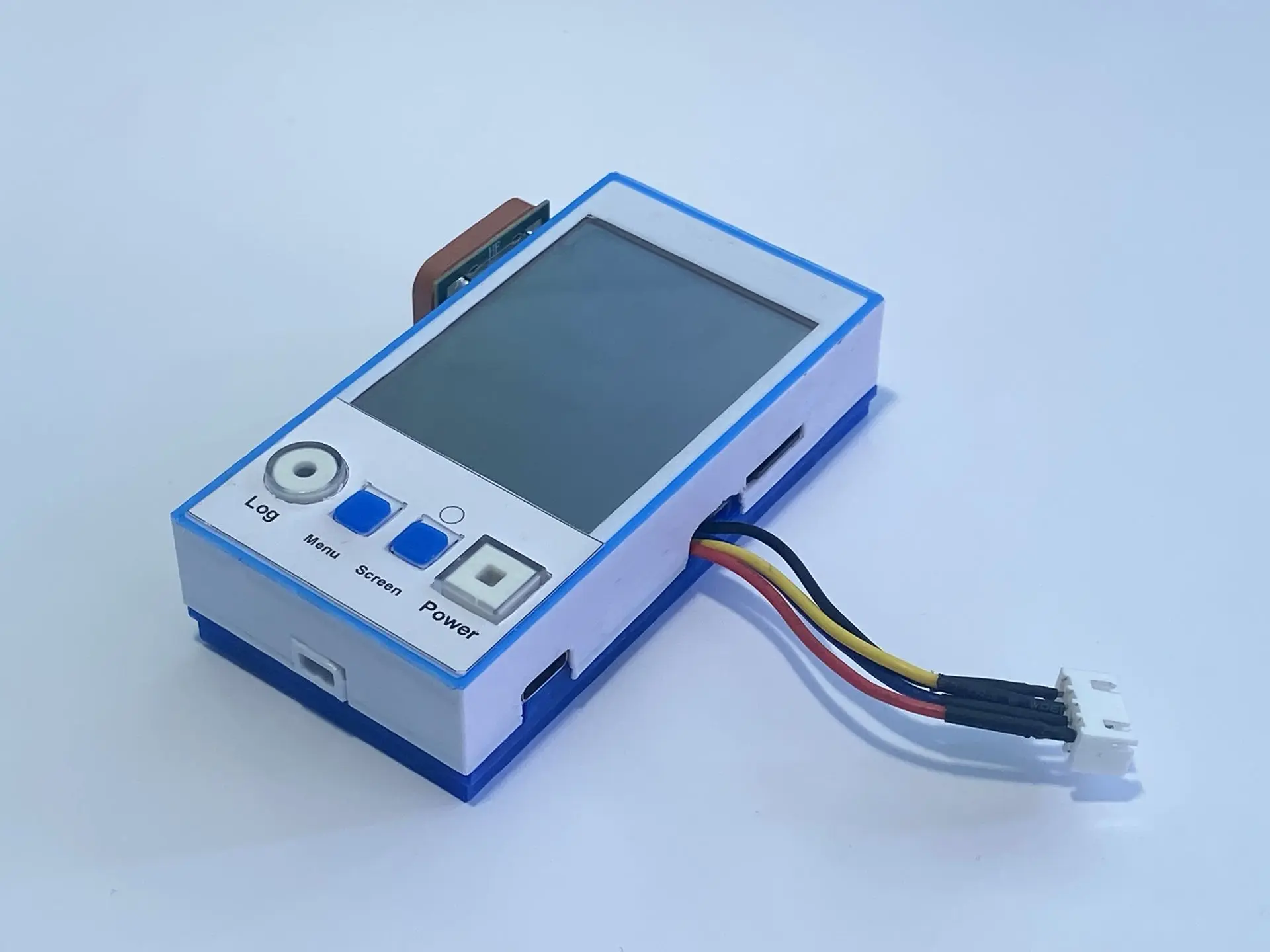
The Sparv Embedded SKH3 is our second-generation airborne data logger, born from years of on-board drone integration and field experience since the 2016 SKH1 launch. At just 90 × 47 mm with a lightweight design, it combines a bright 2.4″ color touchscreen with mechanical buttons and LEDs to streamline troubleshooting and status checks. Internally, it offers 128 MB of non-volatile memory with optional microSD backup, while onboard protections guard against over-voltage, under-voltage, reverse polarity, ESD, and shorts. Equipped with dual-core processing, built-in GPS, barometers, and real-time clock, the SKH3 natively supports Sparv’s SSP sensor protocol alongside I²C and RS-485 ports for third-party devices. Extension cards unlock additional connectors without cluttering the main board. Comprehensive PC tools and open firmware support ensure seamless data retrieval, analysis, and customization, making the SKH3 the go-to platform for reliable, extensible drone-mounted data logging.
Main Attributes
- SKH3 shrinks advanced data-logging hardware to 90 × 47 mm while enhancing robustness and user experience
- 2.4″ touchscreen and intuitive UI greatly simplify troubleshooting and real-time monitoring
- Built-in memory plus optional microSD backup secures critical flight data
- Protected ports and electronics withstand voltage and electrostatic hazards
- Native support for Sparv’s SSP protocol, I²C, and RS-485 ensures plug-and-play sensor integration
- Extension cards allow custom connectors without compromising motherboard design
- Cross-platform PC software and open APIs streamline data access and system customization
A Platform Optimized for Reliability and SWaP
The SKH3 is engineered around size-weight-power (SWaP) optimization without sacrificing durability. Measuring 90 × 47 mm (smaller than a credit card) and weighing just 70 g plus battery, it can be trimmed to approximately 25 g. A 240 MHz dual-core processor with floating-point unit, 2.5 MB RAM, and 4 MB flash drives high-speed data handling. The PCB adheres to IPC-2221B and IPC-2222B standards, and all ports feature ESD, over-voltage, reverse polarity, and short-circuit protection.
Intuitive User Interface and Troubleshooting
A vivid 2.4″ color touchscreen paired with four mechanical pushbuttons, three status LEDs, and a speaker makes on-device interaction seamless. The SKH3 actively detects common faults—battery issues, sensor failures, communication errors—and ranks them in plain English. Transient events are logged for post-flight review, accelerating root-cause analysis and reducing downtime.
Flexible Sensor Integration
SKH3 ports use Sparv’s SSP (Sensor Serial Protocol) for plug-and-play compatibility with native Sparv sensors. Four isolated I²C ports and one RS-485 port handle third-party devices via ribbon-cable adapters or direct reconfiguration. Built-in sensors include GPS (passive or active antenna support), dual-calibrated barometers, and high-accuracy timing from GPS and an onboard real-time clock. Extension cards provide additional connectivity modules and are automatically recognized by the logger.
Power Management and Protection
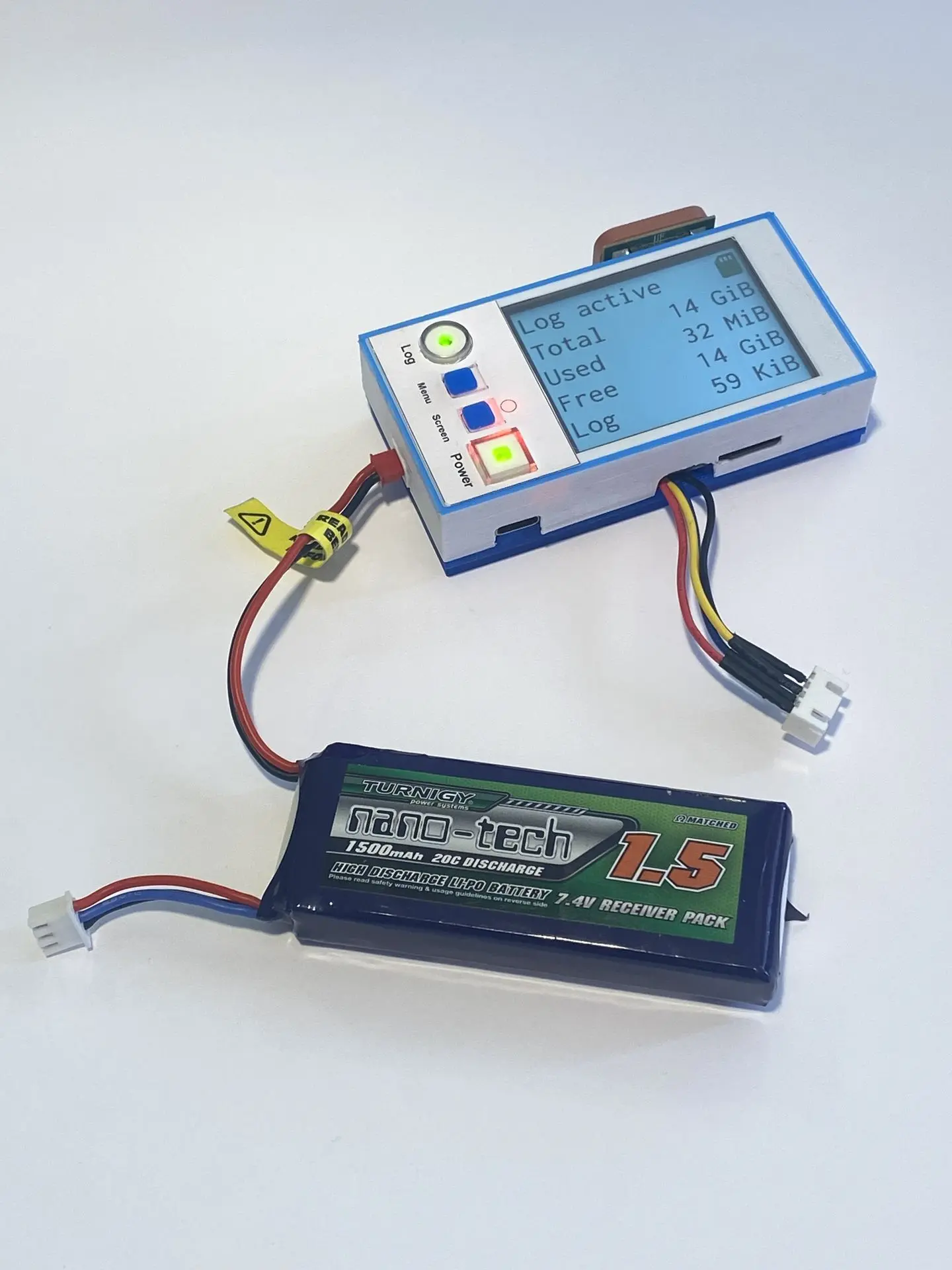
Power options range from internal 3–5 V sources to external 5–17 V batteries. A microampere-level hibernation mode with scheduled wake-ups maximizes endurance. Onboard measurements of current and voltage estimate remaining battery life, while a backup cell ensures safe shutdown during glitches. Hardware and software fuses protect against up to 60 V surges and reverse-voltage events.
Connectivity and PC Tools
Connectivity includes USB-C, Wi-Fi (2.4 GHz, 802.11 b/g/n), and Bluetooth 5 LE. Optional long-range telemetry modules plug in via extension cards. A cross-platform graphical application for Windows and Linux reads logs, plots real-time data, configures sensors, and integrates with custom scripts. Modular software blocks simplify quick development of bespoke PC interfaces in Python or other languages.
Development and Customization
Sparv Embedded offers turnkey customization services for unique use cases. Customers can extend firmware in C/C++ using PlatformIO or Arduino in minutes. A KiCAD PCB template accelerates hardware integration, and a Python library streamlines sensor interfacing, data visualization, and GUI creation for tasks like calibration procedures.
Meet our team

Mattias Wilzén
Head of Finance & Customer Accounts
Oversees financial performance and ensures smooth operations for our customers, from order to delivery and ongoing support.