
Executive Summary
Modern weather prediction models now deliver forecasts at finer scales, but the number and quality of in-situ atmospheric observations lag behind, creating a critical “data gap.” Windsond S1, launched in 2014, addressed this need with a small, economical radiosonde designed for boundary-layer soundings up to 8 km above mean sea level (MSL). Building on that success, Sparv Embedded’s Windsond S2 extends capabilities to 10 km MSL while maintaining a compact 9 g form factor. The S2’s upgraded battery, two-way telemetry, and rugged design make rapid, reliable soundings possible in challenging environments. Requiring up to 30 % less helium than traditional sondes, and capable of tracking 126 units simultaneously, Windsond S2 delivers high-resolution temperature, humidity, and wind profiles for research, education, and model validation. Here, we review the S2’s technical specifications, highlight real-world use cases, and discuss how these lightweight radiosondes help close the observational data gap for high-resolution weather and climate studies.
Key Learnings
- Windsond S2 weighs only 9 g yet reaches up to 10 km MSL with robust telemetry.
- Two-way radio link and improved battery life enable longer flights in remote areas.
- Compact design reduces helium consumption by up to 30 % compared to standard sondes.
- Supports simultaneous tracking of up to 126 sondes to map fine-scale atmospheric variability.
- Ideal for boundary-layer research, educational outreach, and validating high-resolution models.
- Rugged form factor withstands field launches in harsh environments.
Addressing the Observational Data Gap
Advances in numerical weather prediction (NWP) have outpaced our ability to collect in-situ data, especially within the crucial lower troposphere. This mismatch limits forecast accuracy at local scales. Radiosondes, balloon-borne instruments recording temperature, humidity, and wind profiles, remain the gold standard for atmospheric sounding. Modernizing these sondes is essential to supplement remote sensing and support emerging measurement platforms.
From Windsond S1 to S2: Evolving Portable Radiosondes
Windsond S1: Proven Boundary-Layer Soundings
Introduced in 2014, Windsond S1 combined a 12 g package with low-cost construction to deliver trusted profiles below 8 km MSL. Researchers worldwide deployed S1 sondes for wildfire-weather studies, university field courses, and operational campaigns.
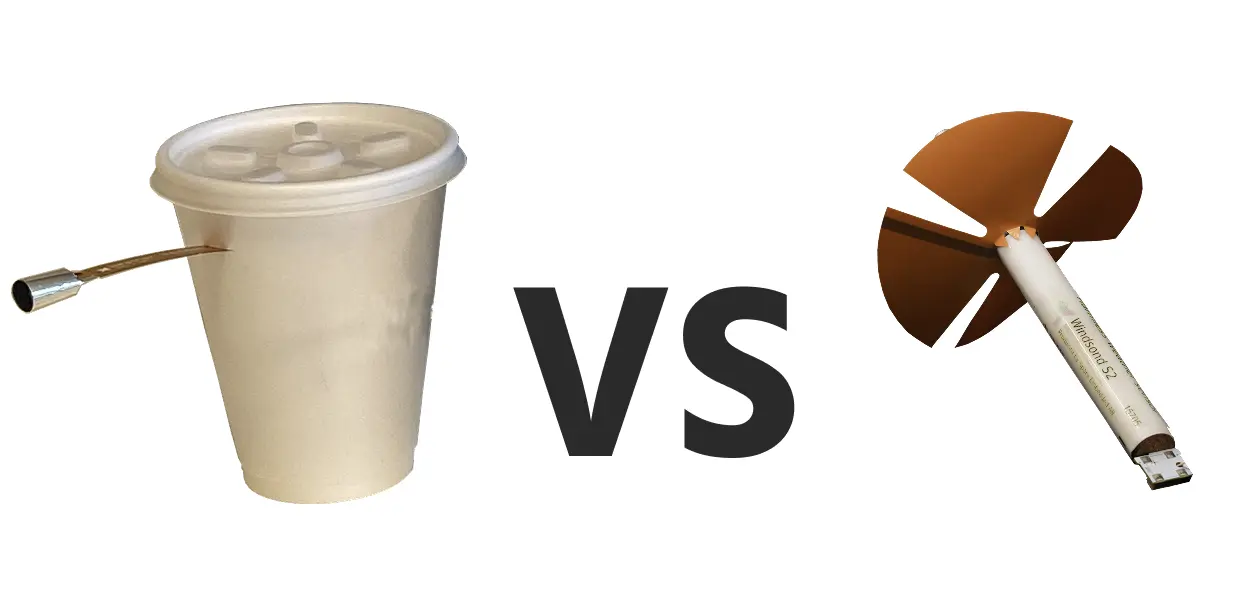
Windsond S2: Enhanced Capabilities
Windsond S2 retains the S1’s portability and affordability while introducing:
- Extended altitude range to 10 km MSL via upgraded battery and telemetry
- Reinforced housing for launches in rugged or wet conditions
- Two-way radio communication for real-time data flow and improved link stability
- MicroSD logging and automated cut-down options for recovery
Technical Specifications of Windsond S2
Specification
| Conventional Radiosonde | |
Weight | 9g | 60-80g |
Maximum Altitude | 10 km MSL | 30 km MSL |
Telemetry | Two-way radio, up to 8 sondes per receiver; 126 sondes max | Two-way or one-way, single sondes |
Helium Consumption | 30 % less than standard sondes | Higher helium volumes |
Data Logging | MicroSD memory | Onboard or ground-based only |
Recovery Features | GPS-guided cut-down and parachute | Varies by model |
Environmental Rating | IP67-grade waterproofing | Depends on manufacturer |
Real-World Use Cases
- Fire-Weather Campaigns: S2 sondes captured rapid boundary-layer changes during prescribed burns, refining microburst forecasts.
- Educational Outreach: University classes and high-school clubs launched S2 sondes to teach atmospheric science fundamentals.
- Model Validation: High-density launches—126 sondes in a grid pattern—mapped spatial variability to validate WRF and other NWP models.
- Remote Fieldwork: Rugged design and extended link range enabled soundings from remote mountain sites with minimal logistics.
Closing the Loop: Validating High-Resolution Forecasts
Data from Windsond S2 offer unprecedented temporal and spatial resolution in the lower troposphere. By assimilating these observations into NWP models, researchers can:
- Improve representation of diurnal boundary-layer dynamics
- Enhance forecast skill for convective initiation and local wind events
- Provide ground truth for satellite and lidar remote sensing
Conclusion
Windsond S2 embodies the next generation of lightweight radiosondes, pairing ultra-portable design with extended altitude range, robust telemetry, and efficient operations. By filling critical observational gaps in the lower atmosphere, it empowers scientists, educators, and forecasters to achieve finer-scale insights and greater forecast accuracy.
Sources:
- Stouffer, R. J., et al. (2024). An Investigation of Convective Boundary Layer Depth and Entrainment Zone Properties Using Dual-Polarization Radar and Balloon-Borne Observations.
- Markowski, P., et al. (2018). Aboveground Thermodynamic Observations in Convective Storms from Balloonborne Probes Acting as Pseudo-Lagrangian Drifters.
- Sparv Embedded AB. Windsond S2: Next-Generation Portable Radiosonde. https://sparv.io/products/windsond
- Chilson, P., & Petersson, A. (2025). Using Small, Light-Weight Radiosondes to Enhance Capacity for In-Situ Sampling of the Lower Atmosphere. EMS Annual Meeting 2025. DOI:10.5194/ems2025-401.
About the author

Phillip Chilson
Atmospheric Physicist & Customer Service
Phil applies meteorological expertise to support instrument development, deployment, and data collection. Ensures high-quality data from the Sparv instrumentation suite. Partners with clients to design customized sampling strategies.